Wednesday, September 21, 2016

Backroads to Tennessee

Every night before a driving day, Bruce plots our route for the next day. He makes a little map on hotel notepaper, of which he is extremely fond, and somehow impresses the route to memory. This system of pure intellect has worked exceedingly well for most of this immense trip - and we have come 13,000 miles (20,000 KM) miles in the mystery green Rogue so far.

Today, we are foot down, humming confidently off through the magnificent Blue Ridge Mountains towards Tennessee when a big flashing highway sign throws a spanner in the works. It warns of the need for a detour. There’s been a road-closing accident ahead.

Bruce is furious and wonders if the warning is current. As we approach a chance to exit the expressway, we can see a plume of black smoke in the distance. Oh. A bad accident and the detour will be necessary. So, we get to see Christianburg, by default.

It’s a serviceable little Virginia town, white spires of churches, neatly mown lawns, lots of mowing, patriotic sculptures, a Christian school, a Dollar Store. Out of the town we pass a strange little valley of derelict buildings before the road delves us into the woods and along the Radford River valley.

And then we are in Radford, a university town. Famous. Where immense university buildings do not tower and sprawl, it seems an oddly squat little town, dominated by railway lines. Sports bar, gaming studio, a shop called Screamer, a drive-in burger joint with cars with trays on the windows. Oh, and look at that. Harris Climate-Controlled Mini Storage. Classy. How upmarket. Of course it is a Harris. Oh, I love mini storage.

We are now keeping track of the accident and detour situation on the local radio. Highway 81 is shut down. An articulated tractor trailer has overturned and caught fire on the median strip. The reports tell of miles of traffic backup. Our detour takes 30 minutes before we are back on 81 and heading towards Bristol, Tennessee.

We pause at Maccers for a quick Santa Fe salad and a clean rest room and head forth through rolling farmland. We are in cattle country interrupted by bits of minor commerce. Oddly, it features a vast acreage of used golf buggies. Ah, but there is one of those huge, mown, golf-course housing developments out there. Gee, they must thrash their buggies.

More cattle. Black Angus. Cornfields. Barns. Farms. Darling cornfields. A hoarding advises: Steer Yourself Towards Chicken. And so we do, as it happens, past a big chicken farm. Rolling land, fallow fields, more mature corn. No sign of tobacco.

We pass a lot of self-move vehicles, U-Hauls and rentals of all sizes. We wonder at their stories. Divorce? New job? Heading to college? America always had a very mobile population.

Here comes a steel welding factory with the sign Jesus is Lord. And a vast acreage of semi-trailer trailers.

And now Hungry Mother State Park. What a name. I Google and read out the story of Molly, who with her small child, escaped after being kidnapped by Indians, only to die of starvation in her flight to safety. All her child could say when she was found in the woods were the words “hungry mother". Oh, that is so touching. One can only imagine that poor Molly’s plight.

As is the cross-country way, the lovely landscape suddenly become utilitarian. Here’s a whole field of abandoned trailers. And now an elaborate log cabin alone in the centre of a spreading pasture. You never know.

Abingdon. Damascus. A big intersection with clusters of fast food joints, petrol stations and accommodation. And now we enter Tennessee - The Volunteer State.

A huge Confederate flag billows from the top of a hill. We spot deer at the roadside. Churches, churches - and mountains making pointy silhouettes on the horizon. Past miles of mown fields, falling-down barns, and forested slopes, we drive towards those rising beauties. On the radio a song choruses "dancing in the bed of my truck in the Tennessee moonlight”. It’s quite a cultural immersion.

And there’s more. A huge hoarding advertises The Holy Bible. Another touts Sweet Lips Diner - Home Cooking. And here comes the birthplace of Davy Crockett, the Davey Crockett State Park and the historic site of the Crockett Tavern.

The mountains are near now. A prettiness of blue ridges stretching in rows to the left of us. Bruce reminds me that some of his ancestors dwelt somewhere in them thar hills.

A distillery offers free tastings. We are amused but not tempted.

We take the Pigeon Forge turnoff and find ourselves on a multilane highway which will lead us right into the glorious Smoky Mountains. Oh, what a vast and spectacular backdrop they make. Beautiful mountains indeed. But this is a main road and soon it brings us big signs and an increasing density of commerce. We run a gauntlet of ticky-tack tourist shops: moccasin shops, trading posts, antique shops, vape shops, a pawn shop, carvings...

And our destination.

It is the road into Pigeon Forge. A bling church with golden spires and cupolas glitters among buildings ahead . A huge statue of Dolly Parton greets us.

Dollywood, here we come.

But wait. It won’t be fast. It seems we’ve hit a big Dolly traffic jam.

Friday, September 16, 2016

An arty interlude in Roanoke

The historic Hotel Roanoke is an old hotel, albeit not as old as its Tudor facades would like to suggest. It is also huge. It used to dominate the Roanoke town centre but an even larger, brutalistic new structure seems to have been built right in front of it since last I was here. It’s an art gallery.

We check in to the hotel. I requested

a mountain view room. I seem to be looking at the new gallery, the railway lines, and other buildings but there are mountains beyond. Actually, since the town is ringed by mountains, one can’t not have a mountain view. It is the tiniest room we have yet experienced. Minimal facilities but a lovely bathroom. It is very olde worlde really and, we presume, these proportions ring of old-style hotel accommodation. We squeeze our mountain of luggage in and go exploring.

So odd. We have to cross the hotel forecourt into a modern and not very

nice glass structure and take the noisiest and bumpiest escalator in history up to a covered overpass which crosses the railway lines. At the other side, we take another escalator down to street level - and we are in the town, but scratching our heads at the logistics at
what must be the most elaborate rail crossing in the world.

We are badly in need of a walk so we scope out the town the long way, walking through what must be business districts. The place is pretty quiet.

We saw not a single Virginia tobacco farm on the road here but the heady fragrance of pipe tobacco wafts out of a shop doorway. That rich, sweet aroma draws me inside to look upon the rows of undisguised cigarette packets, the giant jars of fresh, loose tobacco and a couple of affable Southerners contentedly puffing on cigars at the counter. It is a convivial tobacconist world, a remnant of a soon-to-be bygone era. I breathe in both the perfume and the cultural moment.

Returning towards the market-place centre of things, I spot some striking-looking garments in a quaint corner boutique and slip in to check them out. Oh, deary me. Aren’t I the odd one out. A small gaggle of young women turn and give me a dismissive glance as an assistant approaches and suggests I may find the discount clearance clothes up those stairs. I am not badly dressed but clearly I am downmarket by their standards. I had fallen into a niche of Southern Belles. Indeed, the shop is absurdly overpriced. I make a hasty retreat.

A big stationer’s shop looks more appealing. I am in the market for postcards. I pop in. How very odd. The biggest collection of cat themed brick-a-brack I have ever seen. And gag gifts. Every corny gag gift you ever saw. Yes, they have all sorts of cards. Hundreds. Not post cards, of course. Just cards. And Mennonite women in their long pale frocks and neat little head coverings in there looking at them. Heavens.

We repair to the hotel, checking out

the restaurants around the little market square. There are lots and lots. But tonight we are going to dine in the famous Hotel Roanoke dining room. It is very formal. We frock up accordingly. Our liveried waiter greets us in a big, theatrical voice. You must be an actor, say I. How does she know?, he asks my husband. Oh, she’s been a theatre critic for 50 years, says Bruce. Any good shows on in town?

The waiter does his best to impress and to advise. Theatre seems to have died a death in Roanoke. Venues closed. Companies gone. He does some script reading work with a university script development group.

All very interesting. I don’t want to seem disinterested, but I could kill for the glass of wine I ordered. The restaurant is not very busy. Our fellow diners, however, are very old and old school. Beautifully dressed.

The meal of shrimp and grits with deep-fried okra is classic Southern Cuisine - a must-have. It is pleasant. The dessert, which purports to be a pavlova of sorts, does not know what it is and is classic dire cuisine. It can’t be forgotten fast enough. Maybe it explains why the place is not so busy. It has seen better days.

Breakfast is another story. The same dining room is bouncing with action. There’s a big group which seems to be staying for a wedding. There are families. There are classy seniors. And lots of waiters. The buffet is spectacular. It is a whole room lined with choices - egg dishes, sausages, bacon, porridge, cereals, fruits, cakes, pastries, french toast, waffles - plus a chef cooking omelettes to order. I am fascinated by the big salver of spoon bread. It’s a southern speciality. You’ll like it, says the omelette chef. But I like it best with honey. Tentatively, I spoon myself a small serving of spoon bread. He brings me some honey. I try it. I swoon. It is corny, custardy, cakey divine.

I gush to the table waiter that I am in love with the spoon bread. He tells me that it is the ancient specialty of the Roanoke, a recipe unchanged through the hotel’s history. Every chef who comes to the hotel must master this recipe or he/she will not be working here. There ya go.

We go to sleep in our tiny room to the lullaby of freight trains squealing into the night.

We waken to the coolest day for a long time. Late morning we go out and walk some more, finding the market place beginning to fill up with wonderful food stalls. Ah, that’s where the Mennonites come into the Roanoke picture. They trade their produce here. Very nice it looks, too. Indeed, the whole market is lovely. Massive patty pan marrows. Lots of okra. A chap is selling his home-made cakes. He gives me a sample. Oh, me. It is a slice of bliss. Bruce says no. So I buy a cake of hand-made soap from a long-haired, soft-bearded old mountain fellow in a big leather hat. And some maple pecans from another stand.

We eat salads at a covered sidewalk table in a very unhurried market square restaurant, listening to the lilt of southern accents, and then head for the imposing modern gallery which now dominates the town.

It is the Taubman Museum of Art. On entrance, it seems a quite peculiar. From a vast, airy wasteland of a foyer, we are instructed to climb a mountain of stairs and then take

an elevator. The exhibits are on some middle level and there is a good balcony for looking over the town on the top, we are told.

We end up spending many absorbing hours in this gallery. It has the most fascinating, eclectic collection of mainly American art but some intriguing and even lush European works, also.

Many of the paintings are accompanied by comprehensive little artist bios complete with photos. It adds another dimension of intimacy and interest.

I wish more galleries did this.

There is 19th Century art and there are wild

contemporary installation artworks. All of it with something just that bit different to offer.

Even some sweet little creations by Yoko Ono.

There is no cost to visit the gallery. Toyota is paying, apparently. And the collection has been gifted. It is not like any gallery I’ve seen.

The roof balcony is fantastic, too.

The city view with the busy roads and railways is alive. The mountains are a blue glory. And there are iconic advertisements on the roofs of adjoining buildings.

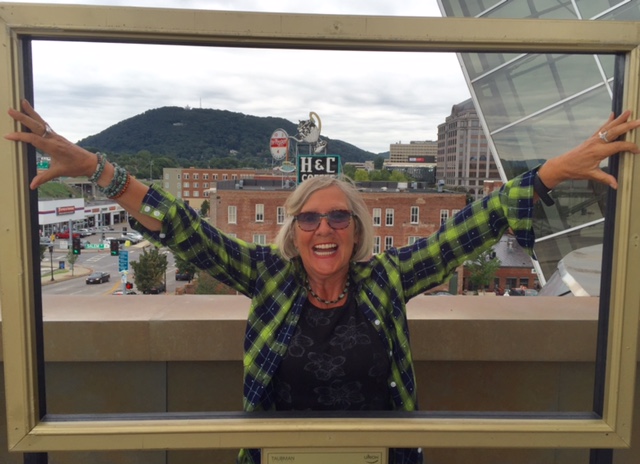
And what’s this? A picture frame in which we are meant to pose for photos. Just try and stop me!

There’s the Virginia Museum of Transportation in an

old railway station on the other side of the railway line. Once again we take the noisy escalator and cross the lines. The exhibition of train photography in the museum has what we think is a high ticket price and Bruce does not care much for trains. We visit the free displays dedicated to the designer of the railway station instead. This is a good move. This is a wonderful show in which we learn about a whole era of American design. This man was the country’s king of logos. He was the master of style and his work has
been around us all the time. He was industrial designer and French American Raymond Loewy. From the late 30s through the 50s, he designed sleek locomotives, cars, and even Lucky Strike cigarette packs. So many of his logos have never been changed. Shell, Exxon and Coke, for heaven’s sake. Another Roanoke revelation.

We take dinner at a local Lebanese restaurant. It is light and healthy. Again we sleep to the tunes of trains grating and grunting on their rails. I eat more spoon

bread drizzled with honey for a morning swoon. And, since the sun is shining, spend the last few hours in Roanoke swimming and lolling by the pool with lots of friendly Southerners who are gathered for a wedding. They tell us all about how awful Donald Trump has ruffled their traditional Republican values and how they can’t stand crooked Hillary Clinton - and how everyone wants to move to Canada, hahaha.

If only it was funny.

The long and winding road - again

And so to Roanoke.

The sadness of leaving Richmond is exacerbated as we pass through the sadder section of the city across the James River. The road out of town is lined with vacant and derelict properties, with businesses and houses boarded up and rubbish scattered about. “Corner boys”, like those we have seen in shows like The Wire, loiter at intersections. The few businesses still functioning have great iron grilles on the windows. Only the tattoo parlours seems to thrive. The few ministries offering God as a solution look bleak out here. God for the Godforsaken. It is frighteningly sad and ugly. For a long way.

We stop at traffic lights and a handsome African American guy leaps from the median strip to knock on the car window. He is snappily dressed in a blue suit with a bright orange tie and pocket handkerchief. He is smiling broadly. He seems to be handing out religious texts in exchange for cash. I don’t find out. Bruce won’t open the window. Not here, he says. No way.

The sign that the world is picking up appears in the form of second hand car dealerships and laundromats. We progress past Dollar Stores and drab little shopping strips, cash-loans offices, more lacklustre little mini malls. A blooming crepe myrtle defies the depression of it all, beaming bright pink from the sidelines.

Finally, finally, the road seems to open up. We are entering the outer burbs and things become more salubrious. Oh, look, there is a shiny, beflagged old Model T Ford on the road. Good grief. The driver is talking on his cellphone. What a killer anachronism. We laugh.

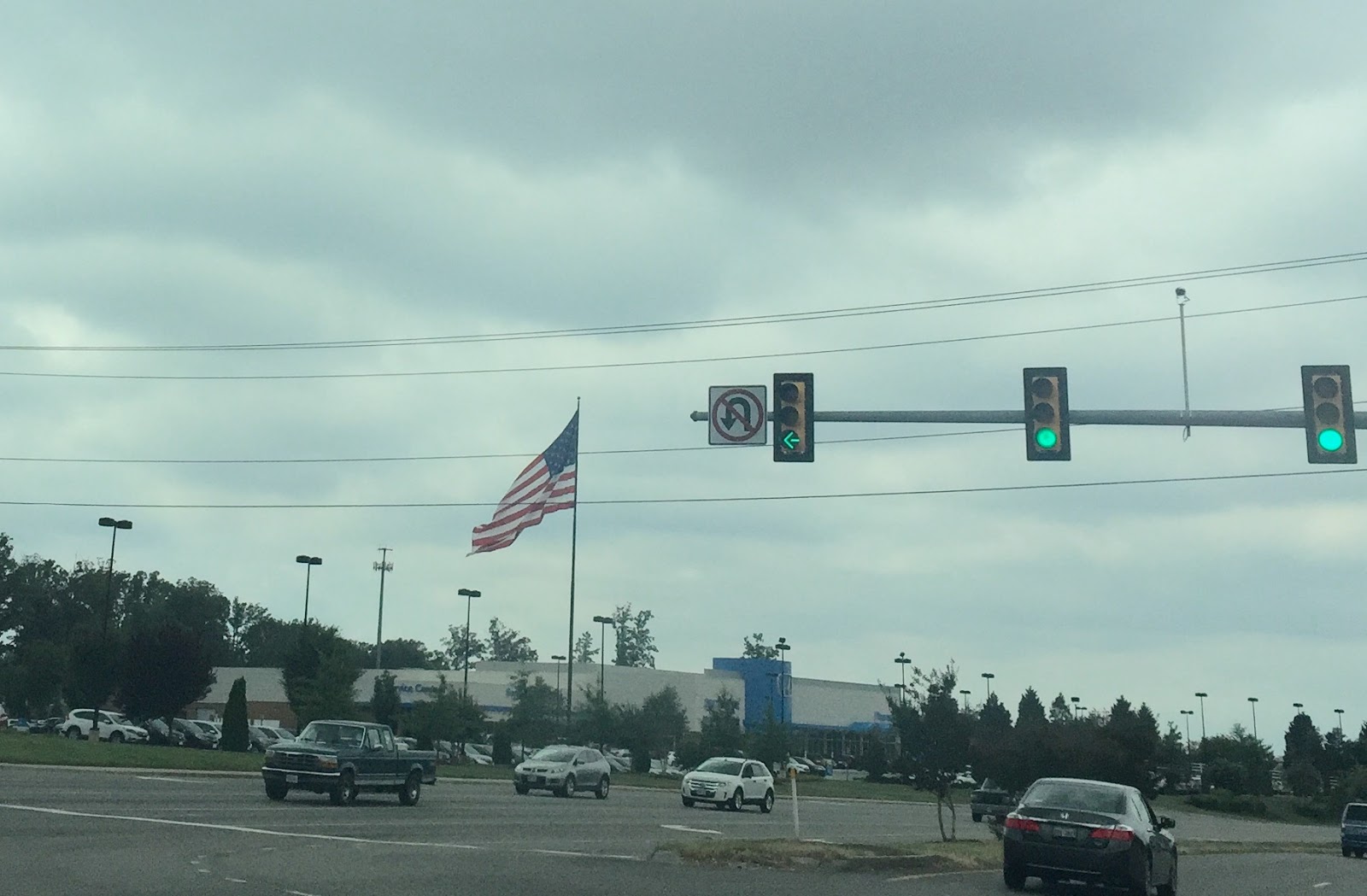
Now the advertising signs spruik Edible Arrangements, Heritage Antiques, Sun Tanning, All Age Learning. There are gateways to posh housing developments and lakefront communities. Here are the big name stores and the flash new car yards. An immense US flag waves over the Honda franchise. Be patriotic, buy Japanese. We laugh.

Humming through the countryside we pass old settlements with wonderful names: Winterpuck, Skinquarter, Winterham, Truxillo, Cotton Town.

Laura Ingraham is on the radio. She’s a right-wing jock and she is revving up the hatred for Hillary and oozing praise for Trump. It spins the brain listening to the vehement venom she ekes out of the true patriots who ring in to express their Christian rage at Hillary’s sins. Oh, what a weird political situation surrounds us.

We turn her off and gaze at roadside pine forests. These are taller and thinner pines than ones we have seen before. And, look, corn fields. My beloved American corn fields. But these are at the other end of their life. They are turning brown. The accompanying soy fields are green, however, vividly so in contrast.

We pass Amelia where Robert E. Lee found his precious Confederate supplies trashed by the Union.

There’s Tobaccoville with no tobacco - supplies trashed by a dramatic cultural revolution. Fields which once grew lush-leaved Virginia tobacco now grow stringy weeds. In some, the forest is beginning to revegetate.

We hum over open road. It looks like a lovely striped ribbon ahead of us, undulating over a softly rolling vista. Bruce talks of Lee’s retreat across this land, with Grant in hot pursuit during the Civil War in the 1860s. We try to imagine those ragged, weary foot soldiers, the thousands and thousands of them covering the landscape en masse.

Ah, and there are hints of autumn on the landscape. Crepe myrtles at the end of the bloom. Yellowing leaves on elms and oaks.

We take the road to Farmville.

Rough pastures. Mini storage out in the fields. Why is so much mini storage out in the middle of the nowhere? Why is there so much mini storage? We pass the turnoff to Saylor’s Creek, another site of a terrible Civil War battle. We are not going there today. We are, however, heading for Appomattox which visit already I have described.

Our immediate view is Trump signs. Huge ones. Trump Pence.

And, over the bridge Lee failed to burn to slow Grant’s hot pursuit, past the sign for Noah’s Last Stop Petting Zoo, and we are in darling Farmville, a civilized town famous for the marvellous Longwood University which began in 1834 as Farmville Female Institute for Women and which only became co-ed in the 1970s.

Bruce’s Aunt Libby lives here and is Emeritus Professor of History at Longwood. Ironically, for the 26 years she taught at this former place of women’s learning, she was the only female history professor. We pause and visit Aunt Libby’s beautiful house, checking it out so we can report on it when we see her soon on the farm in north Georgia. This classic old Victorian house was built in 1904 but its grand old oak tree is much older. It was here when the Civil War troops went by. Right now Longwood is revving up for the vice presidential candidates’ debate as part of the 2016 US election. This is very big deal indeed for Longwood and Farmville.

Farmville also is famous for the breathtakingly immense Green Front furniture and carpet empire which fills the town’s old tobacco warehouses and ships all across the USA. I’d love to go for a meander but it spans six vast buildings and we are not here to shop. We are just stopping for lunch. The town is quiet but the lovely main-street cafe is bustling with life. We devour lovely salads and excellent, proper espresso coffee. The cafe is full of character, particularly a rest room which opens right into the centre of the dining room. Makes one a bit self-conscious but we travellers, when the bladder calls, are grateful for a clean rest room wherever - and in the USA, they are plentiful. Unlike Australia. The miserly and inhospitable loo situation in Australia is a black mark against our culture.

Not long out of Farmville, we’re on Route 64 amid the usual walls of trees when we drive over a rise to behold a great rolling vista topped by a backdrop of blue mountains. We’ve reached the Blue Ridge Mountains. Glorious.

And onwards we hum, over Beaver Creek. This must be the hundredth Beaver Creek we’ve crossed. And the millionth Beaver something. Country people are really fond of naming things after the beaver. Really fond.

Clouds are gathering as we drive past Lynchburg and yet more Trump/Pence signs. Those glorious mountains peek out from between the trees here and there, softly blue on the horizon, topped with fluffy backlit clouds.

More cornfields, dry and ragged. More bright green soy crops. And now a really huge mountain materialises, pointy like a volcano with shrugs of cottonwool clouds around its shoulders. We’re in western Virginia.

Trump/Pence, Trump/Pence.

A roadside hoarding reads: Got mice? Adopt a barn cat.

Now the mountains are looming all around us. Salubrious houses sit smugly back from the road beyond vast expanses of neatly-mown lawns. This is the country of obsessive lawn-mowing. It’s a national OCD, keeping the grass cut.

More traffic now. Trucks. Oh and a goods train over there. Long. It goes on for ever. There is so much to be transported in this busy country.

And, circled by these mighty Blue Ridge mountains, we find our way into Roanoke.

Monday, September 12, 2016

The riches of Richmond

I don’t want to leave Richmond. It has been a wonderful interlude here.

There is so much of interest in this town. We could do with a few more days. But, even on a six-month road trip, we have a schedule to follow.

I am in love with the Crowne Plaza Hotel. It upgraded us to the dreamiest suite on the tenth floor where not only have we had the luxury of spreading out in a way road trippers come to crave after a few months, but also it gives us a 180-degree view of the city. We’re at the pointy end of the hotel. The windows meet in a sharp V. We look across to the James River on one side, down to the old Tredegar Ironworks and

museum and even the great big Federal Reserve Bank. By night the view turns to lively walls of bright lights.

We see bridges and roads and also a city park which is undergoing renovations. We watch the work on the park site with fascination, using our binoculars to see the tree plantings etc. I am addicted to this project and am frustrated we will not see it completed. Similarly, on another side there is a building being demolished by one of those great big balls. Whamp! This also is fascinating to watch.

Coming down. Going up.

It’s the living theatre of a changing city.

We have slipped into a pattern of life in the Crowne, now friendly with many of the staff, loving the lilt of their southern accents. They are outgoing, interested, and interesting. They give us tips on favourite places to visit and tell us things we want to know about the area. The head doorman, a very tall, lean and imposing elderly African American man with a resonant actor’s voice and a powerful Virginian accent, fills us in on the changes in the state’s tobacco history. Virginia's tobacco farming had been his family background. Generations have worked on and loved the industry which had a particular rural rhythm and lifestyle.

But, as we have noted in our drives through the countryside, it has gone. His family has dispersed to other jobs. There are still a few tobacco farms around, he says. We may still see some in Tennessee or Kentucky. But no longer in Virginia, home of the sweetest and most famous tobacco of them all.

The Crowne breakfasts have been divine. Southern yummies - grits and gravy, that incomparable slim and crispy American bacon, biscuits (which are scones), and eggs cooked however you like them by a big, beaming African American chef. Moderation is a challenge. I swim and do my aqua guiltily in

the pool after these breakfasts before we have our adventure for the day.

On one hot day, we take a trolly tour of the city, a very comfortable way to get a big picture of a place with expert commentary. We score that in spades with Melissa as the guide and Rosco as the driver.

Melissa never seems to draw breath. She’s a torrent of knowledge. We see historic buildings and new.

We get fashionably angry with the famous medical school in witnessing its insensitivity in crowding out and spoiling the views of some of the city’s most precious heritage buildings.

We see murals, murals and more murals. Lavish street art covers acres of walls.

We see the elite mansions' district of the city; how the Richmond

zillionaires live. Gothic castles, no less.

We see Monument Avenue with its lofty stone dignitaries, including a statue of Arthur Ashe, a distant relative of Bruce’s it turns out.

We see Richmond’s canal, the famous Shockoe district and Carey Street, and Church Hill.

We are to become a bit familiar with

Carey Street. It is a cobblestone treasure of a street. It is there that we run into the colourful performance artist Elie Elis and her even more colourful poodles. She colours them purple to make people happy and so help world peace. As you do. She leaps into conversation while her garish poodles stand by, tails down, looking decidedly embarrassed.

Oh, she has great projects to save the world. Painted poodles is just one of them.

She proffers her card so that I may have the pleasure of exploring her art which, later, I do. Hmm.

It is in Carey Street where we eat fabulous

meals. Richmond is a foodie city.

First up we dine at Sam’s Grill where the crab soup is one of the most heavenly things we have ever tasted.

Then we try the famous old Tobacco House which is obviously where the swanky Richmonders go.

It is all polished wood with a 3-storey atrium around which the restaurant is set on handsome balconies.It has panelled private rooms. It has tobacco advertising mirrors on the ancient brick walls and a classic old lift taking elderly diners up and down. It has deeply respectful, formally dressed wait staff and to top it all off, the food is

gorgeous.

It is in Carey Street that we set out on our Trolley Tour and where, while waiting for the trolley, we meet a delicious African American woman called Jessie. She is watering verge plots and flower boxes when we fall into conversation. We have plopped down on a shady street bench to watch the world go by on this hot day. As a retired teacher, Jessie is

caretaker for a series of buildings three days a week. The owner, an old friend, offered her the job before she retired. Give me a few weeks to be retired before I start, she told him. Two days into retirement, I rang him up and said I will start yesterday, she laughs. I love to be busy.

She tells us about life in Shockoe Bottom, about the jazz festival, the hip hop festival, the restaurants, and the businesses. Such are the encounters which add depth to the travel experience and embed added warmth to a place. Here they underscore the reputation of The South for its friendliness and hospitality.

We venture far from the prettiness of Carey Street one night to dine at what is touted as

among the tippy top restaurants in Richmond - the Roosevelt in Church Hill. It’s an interesting area, named for St John’s Church, the oldest church in Richmond, in which Patrick Henry gave his famous “Give me Liberty or Give me Death” speech in 1775.

When we try to book we are told the only time slot is 5:15 PM which is a bit early for dinner but, well, this is special. We adjust our food

consumption for the day to be ready for an early meal. The restaurant is in a pretty weird, mixed suburb. Richmond is a city of extremes. One minute we are looking at absurdly sumptuous squillionaire mansions. The next we are in the midst of dilapidated houses crumbling with neglect, people hanging around on the streets, fiddling with broken cars… These streets are a bit scary. One does not hang around.

But gentrification rules these days and this restaurant is on the edge of such a suburb. There is a quality of quaint to the surrounding houses, downmarket but not destitute. Their house paint is ok. The inhabitants seem to be mainly white. The restaurant is an older corner shop. We arrive at five and the bar is hopping already. It’s fashionably rustic. We are seated at a narrow table for two and order drinks. I order one of the house special cocktails, the Jackaloupe which purports to be a cantaloupe and lavender concoction with applejack and bitters. It comes with a massive cube of ice. I can’t taste either cantaloupe or lavender. Just applejack and maybe soda. The mussels

steamed with ginger are divine, though. The glamorous scallops main is okay. But the piece de resistance is, and I’m now stuck in a zone of calorific remorse, a foie gras pound cake with berries and gelato. I had to try it. The very idea of a foie gras dessert tickled my curiosity. It seems they replace some of the butter in the pound cake with foie gras. Who on earth thought of that? Do you know, it was just gorgeous. Only the faintest hint of liver. But another sort of wicked richness. Why did I forget to photograph it?

There are lots of things to like about Richmond, apart from the food and history.

I never do get into its retail area. Bruce is a devoted anti-shopper and streets of interesting boutiques and gift stores are his idea of hell.

But we do go to the cemetery.

It is called the Hollywood Cemetery, not because of any association with movie stars but because of the holly tree and its wood.

It is a rhapsodically beautiful place.

Immense.

One must drive, curving around meandering roads which wind up and down hill slopes and along the bank of the James River. The trees are glorious: blooming crepe myrtles, huge old maples, oaks and elms.

Graves and crypts, flagpoles and memorials pepper the slopes as grey sculptural shapes.

They are very old, many of them. And departed figures of the American Civil War predominate along with the old gentry of Richmond.

Hollywood brags several US Presidents - James Monroe and John Tyler. And, to Bruce’s immense excitement, the great Confederate States’ President, Jefferson Davis. He was the South’s counterpart to

Abraham Lincoln. After the South lost the war. he was jailed for treason, even kept in shackles for a two years but in the end he was to be known as “the hero of the lost cause”.

There are myriad Confederate generals and notables buried here. Unnotables, too. And there are US congressmen, Pulitzer prize winners, judges, diplomats and governors.

And there is a little girl. A toddler.

No one is quite sure of her name. Maybe Bernadine Rees.

She was not yet three when she succumbed to disease, maybe scarlet fever, in 1862.

What everyone does know is that she has a guardian standing over her grave, a life-sized Newfoundland dog. He’s known as Iron Dog.

The story goes that Iron Dog’s owner put him there because the little girl so liked to pat him.

He is splendid.

He has a serene, eternal expression.

He guards the tiny grave whereon people pop small gifts, little toys and candies, and things a toddler may like. Touched by the spirit of it all, I leave a little koala.

Hollywood is one of the world’s magnificent cemeteries along with Paris’ Pere Lachaise and Savannah’s St. Bonaventure. It is a glorious park of ghostly grandeur and a pride of Richmond.

There are things we have not managed to do. So many museums. The Edgar Allen Poe House. He’s believed to be a distant relative of mine. I would have liked to pop in. We do not manage the art gallery either with its great collection of Faberge eggs. But that’s alright. I saw them last time.

We have done all we can fit in and it is time to move on.

And so, with mixed emotions we pack the Rogue once again and return to the open road and our next adventure.

Friday, September 9, 2016

Dodgy Coke in the 1700s

Twice before I’ve been to Richmond but never to the famous Colonial Williamsburg. This has to be remedied. Of course it has to be a stinking hot day when we make the trip. This searing heatwave has pretty much followed us across the USA since South Dakota. We tough it out.

The oddest thing happens when we arrive at the Williamsburg Visitor Centre to buy our tickets for the day. A sportily-dressed Chinese-American couple approaches us and asks if we will be part of their tour group. They need 15 and have only 13. Two more and they can obtain a discount price. We will be part of their discount price if we join their group. No strings attached. We never have to see them again. How about it? Hmm. OK. So the woman, who turns out to be a New York banker, liaises tour tickets while we chat to her partner who turns out to be a New York pathologist. She gives us the tickets. We never see them again. We have saved $40.

Williamsburg is not too crowded on this hot week day. This is good.

We are no sooner off the shuttle bus and through the gates than someone fires a musket very near at hand. Boom! I am ten feet in the air.

It is part of the shtick. There is a learn-to-fire a musket shack. Not a very useful art, if you ask me.

We are surrounded by 18th Century ticky tack. They call it the market place.They have stalls selling lovely period straw hats. $35. They are selling cookery books and vanilla pods…

But not modern day drinks.

We are feeling as dry as a dingo’s dick and need to hydrate if we are to walk this quite considerable recreated town.

We try another period shop. No drinks.

We see a sign. How odd. Drinks around the back.

We go around the back of an historic building and into a lovely little courtyard crammed with picket fences and beautifully-groomed hedges. We spot, on the far side, a tiny outhouse within which are two huge modern drinks vending machines. One has just water and the other assorted fizzy drinks plus water. The one with water has an Out Of Order notice pinned to it. We put a credit card in the other machine and try for water. No go. Try again. No go. Puzzle for a while. Try again. It must be out of water. Diet Coke, then. Hey presto. A bottle rolls out. But it is only a third full. It is sealed and cold and straight from the machine. But it is only a third full. Weird. Perhaps the machine is rebelling against being an anachronism in a period town.

I take the drink to another period shop where a woman talking in quaint olde worlde English is selling quilting materials. When she sees the bottle and hears my story, she dissolves into hysteria. So sorry I find this funny but isn’t it funny, she says, completely dropping her 18th Century character.

Clearly, not a lot of funny things happen in Williamsburg.

When she has composed herself, she produces an anachronistic telephone from under the counter and calls the ticketing store where she subsequently directs me to receive a refund.

And indeed, a woman in period costume and talking in period style, takes the dud bottle and gives me some proper modern money. No, they don’t sell drinks in there. But I can go next door to the tavern. There, a man in period costume, talking in period style, takes my modern money and hands over an
ice-cold bottle of modern water. Now we can look at the living museum which is Colonial Williamsburg, the Revolutionary City, once the capital of Virginia and loyal to the British Crown.

It is not what I had expected. It is such expansive real estate. The main road is so terribly wide. It seems strangely sparse. Horses with carts are standing about. Some clop slowly up the street.

It’s how it was. The Americans do these things very lovingly and carefully before they make a fortune out of them.

This recreated town is extremely proud of its historical integrity - to the point that its blacksmith shop makes all the nails and locks

and bars and rails and assorted metalworks exactly as was done in the early days and these things are used in the restoration and maintenance of the property.

We visit said blacksmith shop which has smoke soaring from its chimney and watch heavy work going on. It is a working enterprise. A red-headed girl in period garb tells us all about it as we watch the smith pulling red-hot iron from the fire and beating it to form.

We see the carpentry shop,too. It is the same story. The workers in there

are artisans proudly practising the techniques of their forefathers.

We visit the grand old courthouse. It provides a bit of a sit-down while we listen to a costumed woman give colourful descriptions of criminal justice of the time. The stocks are just outside where people were pinned in by their heads. For good measure they used to nail criminals’ ears to the wood while they were in there. Bruce is fascinated by this piece of new information. We need to look at those stocks very carefully.

We walk slowly in the heat. The kitchen garden is extensive. It is wonderful. It sells all sorts of period equipment as well as heritage seeds.

Walking down one handsome street, we meet a woman

who seems to be rallying folk for a talk. We join in and find ourselves sitting upon benches in a garden, hearing all about an important townsman and his lovely house. Once we have heard his story, rattled off in the mode of a guide who has told this story too many times before, we are invited to inspect his lovely old house. And his lovely formal gardens. It is, of course, lovely.

Oh, and look, there is the slave house. And slaves were allowed to have their own little gardens. Lovely?

We walk on, past pleasant buildings. Not everything is living demonstration space. But this one is. It is the Governor’s Palace.

A young performer in period garb gives us his all. He knows his stuff and he has panache. We move from room to room learning of the grand life of the privileged in this grand old mansion, in the recreated era inhabited by Lord Dunmore. As we move into the grand ballroom with its paintings of king and consort, our guide executes a sweeping formal bow from the waist and suggests his surprise that we all have not done so in respect to the British Crown. We are tutored in formal bows of the period and we do the right thing. This lavish ballroom is painted a vivid shade of erk green, which apparently was the chic colour of the day and was believed to stimulate the appetite. The room also is carpeted, hand-made carpets being ever so prestigious at the time, says the guide.

The erk green clearly has conveyed its message. We are hungry. We repair to Chowning’s Tavern in the main street where a woman in period garb takes our name and tells us we have 15 minutes to wait for a table. We sit and watch the world go by - well, the tourists. They are a mixed bunch. Mainly American.

We are led to a table upstairs in this handsome old inn building. Everything is rustic, especially the stairs. Signs warn you how rustic they are. Take care.

Waiters in period garb take our orders from a period-style menu. Astonished to find them on the menu, I choose pasties. Bruce orders Brunswick stew.

A young girl in period garb comes in and plays old tunes on the fiddle. She will do any requests of popular 18th century songs, she says. Silence from the diners. She plays on.

The food is terrific.

Now we head off for the Capitol building, the most important building in the town, the head of law and government. A splendid edifice it is of beautiful decorative brick work.

The original was destroyed by fire. This is a painstaking recreation.

Our tour guide appears to be a fairly mundane, dumpy woman unflattered by her ill-fitting period garb. And then she starts to talk. She turns out to be a wonderfully well-informed teacher who knows how to engage attention. She leads us through the processes of government in a series of handsome great chambers and finishes with a mock trial in which she selects the children in the group and gives them roles to play, thus ensuring that they are thoroughly involved and learning. It is charming and edifying. We adore this guide and the experience in general.

But we are feeling just a bit spent in the heat. It is a bigger town than one had imagined. We have done a lot of walking.

The day is no longer young.

We meander back, stopping at little mock shops, talking to the odd costume performer on the job as local colour. Oh, look, a post office. We go in. It not only sells cards but it postmarks them and dispatches them. Yes, please. My grandies are covering the fridge in the postcards I send from this epic road trip. They will love these.

And then it is back on the shuttle bus which takes us all around the modern, working, residential town of Williamsburg for pleasant good measure as we head back to the vast souvenirs hub of the visitor centre and the carpark.

Oh, and don’t we appreciate the air conditioning when we get there.