Showing posts with label butte. Show all posts

Wednesday, November 16, 2016

Arizona the beautiful

Dear old Phoenix. We love you again. We love our Tempe at the Buttes Marriott which is nestled right in and on a splendid old butte. Was there ever a more magical place for a resort hotel? Our room opens onto the beautiful gardens and steps up to the pool. The pool winds around the butte; two large pools joined by a channel, looking up to a waterfall and cactus
-covered rocky butte slopes. The mood is easy.

My back is annoying me. A sort of rash is appearing. Hmm, says Dr Bruce. That looks suspiciously like shingles. But I had the Zoster vaccination, say I. Hmm, says Bruce. It doesn’t work on everyone.

Onwards, we must go. We are scheduled to be in Sedona and the election is tomorrow. Arizona has not been too fiercely covered in

Trump posters. It is John McCain’s comfortable electorate. But the media has been a foment of political bile of the most unprecedented ferocity. The campaigns have hit a gutter low. Trump is at home, chanting and bellowing with fire and brimstone and evangelistic fury. His speeches are tantrums. It boggles the mind that so many Americans are sucked in. But they have been on the Fox political hate diet for years now. They have been conditioned to the hatred of Clintons and heavily marketed with the concept of an evil political elite which wants to take their guns away. They are not politically savvy. They are gullible and jealous. Trump feeds these emotions. He struts the political stage like a superstar, giving speeches in front of his parked Trump plane. Hillary erudite and experienced, ripe for the role of president, has a huge burden of mistakes behind her, sexism and misogyny all around her, and now, at the 11th hour, the FBI of all things, throwing a new email scandal in her path. Everything is very stressful and dangerous. We hope there will be a good TV in Sedona for us to watch the election unfold.

It’s a big smoggy out there in Phoenix today. 91 deg F. We whoosh along the speeding 10-lane highway out of town, past schools and industry, past oil tankers queued on rail lines. Palms and eucalypts dominate the urban vegetation. We run the gauntlet of relentless commerce on the highways; big, colourful, prosperous, cheerful.

It’s a good highway. Past the University of Phoenix and towards rows of perfectly pointy volcanic mountains and basalt boulder fields.

Burbs with mesquite. Hillsides with saguaros.

We wind upwards into mountains and as we gain elevation, we gain density of cacti until they reach wow factor.

Chollas with the saguaros. Bruce is in heaven. The chollas are blooming.

Desert plants. Adobe-style housing settlements. Those lovely adobe colours.

We are at 2000ft elevation.

The road narrows. The trucks take over.

A sign identifies a mesa as Table Mesa. Bruce thinks this is hilarious. Mesa means table. It is Table Table, he laughs.

The earth has been changing colour. Now we are in sandy limestone. It’s not volcanic here. It is part of the Rocky Mountain uplift, explains Bruce.

We cross Moore’s Gulch and gasp at the spectacle of the sea of saguaros and chollas in the dry creek bed.

Now at about 3000ft, it seems to be a sweet spot for saguaros.

And we are right inside the rolls of the mountains.

More mesas and a large, widely-spread community appears. Black Canyon City. It has a real wild west look to it. One expects to see tumbleweed.

Oh, and a little town called Bumble Bee. Cute.

We keep climbing, amid trucks groaning in low gear and wanting to pass each other.

There’s Horsethief Basin Recreational Area. There’s a name that tells a story.

The saguaro cacti are suddenly gone. The slopes are covered with pretty little prickly pear cacti.

And now we are on a desert plateau. No cactus at all.

Scenic View, says a sign.

Vending Machines, says the sign beside it.

Not my sort of view, say I.

We thunder on amid our friends, the long-distance truckies, past roadside boulders Bruce identifies as a’a lava flow. See, he says, there are two kinds of basaltic lava flows: a’a and pahoehoe. The names come from Hawaiian.

Low scrub lies sparsely on the slopes as a mountain range unfolds itself softly.

We pass Bloody Basin Road. Pale boulders.

A sign to Agua Fria National Monument.

An overpass. A settlement. And back to wide open plains. Low mesquite. No cactus. Lots of a white flowering desert plant we can’t identify.

No services. No nothing.

We are on our own out here, apart from the trucks, of course.

Just vast desert landscape.

Elevation 4000ft.

Yellow dry expanse. Small hills.

A little higher and miniature prickly pears appear again and then, suddenly, a riot of desert juniper.

Green bushes all over. Even a couple of cottonwoods out there.

Signs invite trucks and caravans to pull off here and check their brakes.

And down we wind into a steep, steep valley.

Cars are hooning down like idiots.

Skunk smell. Poor little critter, probable clobbered by a car.

This seems to be Fort Verde State Park.

Red mesas stretch out far ahead across a vista of limestone hills.

This land was once under a shallow sea, says Bruce.

Dead Horse State Park, says a sign.

We take a turnoff. West 260. Oh, look at that Wendy’s Restaurant, disguised as a handsome adobe dwelling. Trees. A treescape with hints of autumn hue. Trump signs.

Sign: Guns. Buy, Sell, Trade. Rental Archery.

Mini storage.

The road goes ahead towards those limestone cliffs Bruce loves.

We can see the rich red striations of the Sedona mountains far ahead.

And here comes a town called Cottonwood. 3320ft elevation. Established 1879.

Sedona is not far away. Over the Verde River with its cottonwoods. Past the Coconino National Forest.

Black cattle. Yellow grass. Prickly pears. Junipers. Sign: Beware of deer. And suddenly a brilliant vista as the red-rock country appears, that glorious rich red rock streaking across the landscape. Yellow cottonwoods, lush vegetation, cactus… Sedona City Limits.

Old Butte Phoenix

Tucson to Phoenix. It’s a short hop. An easy day in the world of road trips.

We’re going back to Phoenix as a sentimental journey. We stayed at the Marriott at the Buttes in Tempe some years ago in the midst of a vicious heat wave and we just loved it.

Of course, we also have loved the glorious saguaro city of Tucson.

It’s the only city I’ve visited where even the trailer parks are ritzy - avenues of tall palms and high walls.

It has roads with names like Sweetwater and Silverbell.

It has a deficit of architectural vulgarity.

It has the Santa Catalina Mountains.

And, whenever it rains, it rainbows.

We don’t hurry our departure. We linger around the pool first.

Oddly, I seem to have a touch of sunburn on my back. I have an olive skin and never have had sunburn and I can’t understand how I have it now, since I have not overexposed myself. Yet my back burns. I put on aloe vera and we drag ourselves away from this world of saguaros. Tucson is one of those low-rise cities which does not seem to have a CBD as a structural core. It sprawls in a big, wide easy way. It is big. It takes a while to get across it.

We decide we’ll have lunch at a Panera Bread. I love this chain. I have wonton soup.

Eventually we are on the road past mesquite scrub and lush, ripe corn crops on big, big flat land. It has been a while since I saw corn which was so much a part of the daily drives across the north of the country. We saw the crops young and watched their development right across the land. I have missed them.

The desert stretches out with craggy mountains ahead.

There’s a huge air base out there with lots of planes. It is clearly not commercial.

Oh, bee hives in the desert. Desert honey. Wish I had tried it.

A sign announces Red Rock. There are quite a few candidates out there. I Google and find Picacho Peak.

Another sign confirms Picacho Peak and yet another one invites us to visit its roadside Bird Farm and Feed The Lorikeets.

Good grief. You never know what you’ll find in the American desert. Caged Australian birds, no less.

Ironically, I spot raptors in the sky. Now, they belong here.

And so do goods trains. There they are out there, pushing their miles of loads overland. This one is Union Pacific. It has three engines at the front, two at the back. Even the graffiti artists can’t handle the volume of rail cargo. Only a couple of carriages show their multicoloured art.

The road is beautiful and wide. Six lanes. Flat and straight.

Sign: Blowing Dust Area.

Crops and shrubs adorn the land. A few cacti.

Hah. Here comes the town of Picacho. A long, long livestock train waits empty on the outskirts.

Police have sidelined an open-top sports car at the roadside.

A sign indicates Casa Grande Ruins National Monument.

The landscape has changed since those Pueblo days. What we’re seeing now is pecan orchards. Huge orchards with lovely lush trees. Fallow fields, Orchards.

And heavy traffic.

We are in another great cluster of trans-continental trucks and big rigs. I catch the eye of a driver as we pass. He is so high up. My father had a romantic notion about the loneliness of the long-distance truck driver. He saw an existential beauty in the somewhere nowhere nature of that life. I wonder what the trucker is thinking.

Billboards dot the roadside. They're mainly for food, delicious chicken wings. One asks: Do You Have Lyme Disease?

Now I spot four planes flying in formation quite low and slow over the desert. Planes and trains and automobiles. Yay!

And, suddenly, eek. There are always a few morons out there who can’t read the road. One such has just swerved past us to speed ahead and veer in front of the next car and tailgate the one ahead. Is he on drugs? Is he in a bad mood? Is he just plain stupid?

One often wonders about who are the other people on the road, where they are going and why.

Cactus seem to have vanished from the landscape. It is dry and dusty. Huge powerlines.

Cotton crops and fallow fields. Horses.

The town of Casa Grande turns up, big and dusty, malls and commerce.

And back to crops. Sorghum and cotton. Some acreage bright green with new growth. Some ploughed and brown.

Sign: Blowing Dust Area.

Mesquite and tufty saltbush plants. Dusty farms.

Another cop car has picked someone up.

We’re on the Gila River Indian Reservation - and cactus is suddenly back on the landscape.

It’s a wide old world out there, broad, flat with mountains on the horizons.

But the land is divided into patchwork irrigated crops. The deserts bloom these days and act as food bowls.

The police whizz by in pursuit of someone up ahead. We hope it is that hoon. We catch up as two cars pull over to the verge ahead of the police car. Hah. They have got that hoon. Oh, no. The hoon is not their target, though his pulling over indicates his guilt. He swings back into the stream of traffic ahead of us. Pfft.

We cross the Gilo River. It is bone dry. Pale, dusty mountains with slopes covered in cactus are around us now and feeder roads bring more traffic into our steady stream. We are nearing Phoenix.

Yep, industrial outlyings, reduced speed limit, mega storage, a racetrack, overpasses, A new line of mountains manifests, its ridges prickled with communication towers.

And hillsides covered in cactus. Here they are again in all their exotic beauty.

A big outlet mall. Very neat and handsome. Through the township of Chandler. Very sleek, tidy, busy, affluent with a big city efficiency to it, complete with traffic jams…

It is an upmarket Phoenix satellite - and here comes the big smoke itself, complete with its spectacular mesas and buttes.

That butte over there complete with ancient saguaros is our destination.

Hello Tempe at the Buttes Marriott.

Saturday, July 2, 2016

A you beaut Butte bordello

Butte is beaut in the way that Newcastle and Broken Hill are beaut. It is an historic mining town which has gained a special beauty through the passage of economic demise.

Butte is in Montana. The old business district historic town sweeps graciously down an impressive hillside, looking over a valley of housing and modern commerce. It is all set in a giant basin rimmed with mighty mountains - for it is part of the Rockies. It is a part of the Rockies where copper was a rich and accessible resource. The result was massive open-cut mines and a thriving 1800s boom town. So densely did it swarm with miners and magnates and all the supporting players of a remote mining bonanza, that it bragged one of the great red light districts of the world. It had a whole bordello quarter. Then.

Now, amid buildings that are crumbling, boarded up or simply gone, one bordello remains - The Historic Dumas Brothel.

Operating from 1890 to 1982 it was America’s longest running brothel.

Now ta-da — it is a Brothel Museum.

One doesn’t see too many brothel museums around the world, so the Dumas hit my “must” list like a wild west bullet. Butte also brags the more famous Butte Museum of Mining and a truly fascinating Mai Wah museum of Chinese pioneering history.

But, no, it was the bordello of Butte for me.

It has to be one of the strangest, and most poignant places on this earth.

The building, purpose built by French Dumas brothers, now stands crumbling

and isolated in old Mercury Street.

It’s easy to find because it is just so crumbling and lonely. Ironically, there’s an antique pram in the street by its curve of entrance steps.

A women calls as we walk into entrance hall. She could be part of a display, there behind the counter with its ostrich feather pens and surrounding clutter of bric a brac. She has a gravelly smoker’s voice. She’s sinewy and of indeterminate age with tousle of blond hair tied up untidily on her head. She’s babysitting the grandies just now. The grandson politely proffers Brothel brochures before he and his little sister are steered off behind a door. Our welcomer is Camille. She gratefully accepts the $8 entrance charge, “cash only, darlings”. She talks with machine-gun rapidity.

A quick run-through. There are three floors. This is main one and you can see some cribs made up.

The working girls came in all ages and some worked into their 60s. The old ones tended to have the basement cribs. The brothel operated 24 hours, the girls sometimes working in shifts. There were lots of tunnels underneath Butte and many of them led to the Dumas Brothel. You can see the relic of one. Most have caved in now.

The most famous and the last madame was Ruby Garrett. The madame received 60 per cent of the takings, the girls the remaining 40. Not that prostitution was ever legal. A lot of bribes went down over the years. Nonetheless, Ruby ended up in jail for tax evasion.

Anything else you want to know, just call out.

And there they are, the “cribs”, furnished with all the things they ever had and then some. This is a museum and some collecting has been done over the years. There’s a lot of stuff.

There’s a lot of crimson, a lot of drapes, a lot of fans and mirrors, shawls and bowls.

It could be a movie set, except that it is so very, very old and tired.

Loved. There is no doubt that it is tended with great care. But one sees a piece of social history dying of poverty - like the rest of Butte.

Areas are sectioned off as “construction sites”. Damp has eaten through walls and peeled away wallpaper and rotted wood. Plaster has flaked or gone. The stairs, as we mount them, creak dangerously underfoot. Upstairs is open in the centre with a passage leading around to all the rooms. The floorboards are a worry. I warn Bruce to step lightly, if he can.

There’s a smart madam’s room with a wonderful old green rotary phone with the biggest numbers I’ve ever seen. There are quite a few assorted antique phones in the place, come to think of it. Booking sex probably came with the invention of the phone.

Sinks and washbowls are prolific - but stories of the brothel’s history pinned to the wall tell of the blight of venereal diseases and the terrible frequency of pregnancy. Butte was abortion central in its heyday. Lacking contraception, the girls had pregnancy after pregnancy, hideous backstreet abortions by unqualified midwives and terrible bleeding and infection. Baby bones found years later in prospector holes around the region.

Some prostitutes went full term and raised children in the brothel.

Others farmed them out.

Depression was an epidemic and so was addiction to the legal drugs so easily available - laudanum, cocaine, opium, and alcohol. Suicides were common.

Ah yes, this place feels spooky for many reasons.

It is notoriously haunted. Ghostly figures and strange lights turn up in photos. Not in mine, I note, with disappointment.

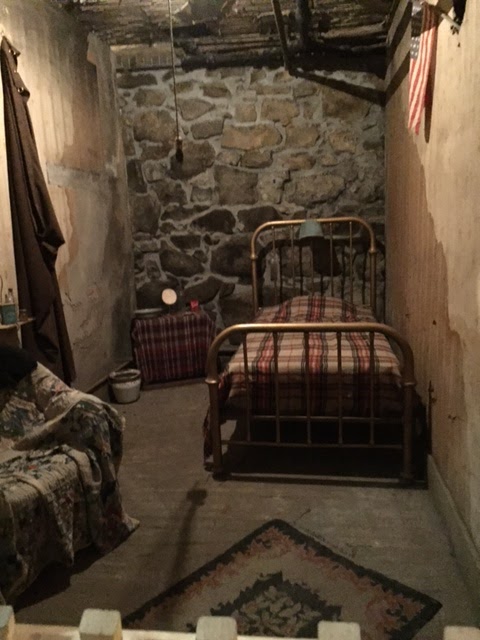
The basement is the saddest area. The corridor is dark and dank, the rooms smaller and less flashy than upstairs. They seem entirely grey and ghostly, weighted down with a weariness one does not feel on the other floors. Bruce feels uncomfortable.

That’s not like him.

We return to the modern world.