Showing posts with label sautee. Show all posts

Tuesday, October 4, 2016

Chattanooga - the good, the bad, the gorgeous

Chattanooga is our destination. We have been dying to visit it for aeons. For me, it has been because of that wonderful name and that wonderful Chattanooga Choo Choo song. For Bruce and Aunt Libby, it is because of its significance in the American Civil War. Aunt Libby has not been there since she was a child.

Usually we could not fit anyone in the back of the Rogue because of our massive 6-month road trip luggage. Beyond the suitcases with which we arrived in the US four months ago, we have accumulated a complex and bulky survival kit which now takes up the entire back seat. There are chiller bags and food bags, pillows, personal bedding for dodgy hotels, a special bag for quick-change shoes, my swim bag, coats, and more. We were able to leave this stuff at the farm and take off light and easy with Aunt Libby aboard for the side trip northwestwards to Tennessee.

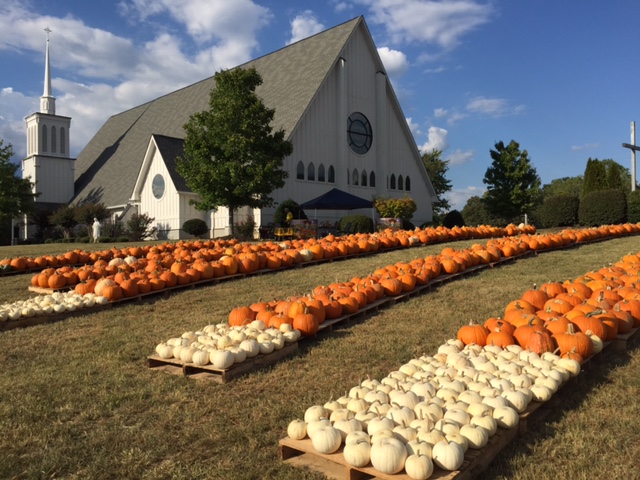
We take the Dahlonega road which winds its way through the north Georgia Appalachian Mountains, past steadily occupied countryside: farmlets, smallholdings, humble houses with gardens and mown lawns, churches, churches, and Trump signs. There is a steady supply of gun shops, often very close to pawn shops. Sometimes they are gun and pawn shops. I suppose one can pawn the wife’s ring and buy a gun. Or pawn the gun and buy a ring? Hmm.

Church, church. There are so many churches. They seem to go with guns and pawn. And, right now, they go with pumpkins. Oh, my, did you ever see so many pumpkins? Are they a religious symbol? Harvest plenty, probably. And, like so many things American, they do it big.

There’s a very dead corn crop. Sorghum, not corn that one, says Aunt Libby. Farmstands selling Crazy Cajun boiled peanuts and biskits. Vote Republican. Vote Trump. Orchards. More farmstands. More boiled peanuts. A sign bids us to Have a Blessed Day. Another offers Appalachian Bail Bonds.

With a burst of giant, towering billboards, the road leads into an exceptionally unprepossessing little valley. We swing onto the Appalachian Foothills Parkway and past Ellijay, a darling town famous for marble, says Aunt Libby. It has a beautiful bronze bear sculpture. Fort Mountain State Park is ahead. And American flags, Trump signs and endless neatly mown expanses of lawn. Oh, the mown lawn phenomenon of the USA. I am becoming fixated by it. The equipment. The working hours. How does the country maintain this epic acreage of grand, green smoothness?

The landscape undulates and the road winds as we rise into the mountains. Trees are tall, leaning over the road, many of them festooned with the lacy, white bags created by tent caterpillars. Mown clearings reveal rustic wooden houses with swing seats on their porches and lots of odd collections of, er, stuff.

Then there are houses with porches as stark and neat as others are zany with possessions. Oh, look, a donkey. A Cherokee trading post does business beneath a brazen Confederate flag.

The road winds upwards, thick with trees. Our ears are popping. A sign touting a mountain overlook lures us to turn off. We bump rather perilously around a U shaped track but we’re still enclosed by trees. Heavens, the forest has overgrown the view.

The road summits and then makes a merciful descent and reveals a small valley community called Chatsworth.

Hungry and in need of a nice, clean rest room, we swing into McDonalds for Santa Fe grilled chicken salads. Rest room is nice. Salad is good. Then Aunt Libby spots the sign. It warns guests not to “loiter”. To sit in the restaurant, food must be purchased and consumed within 30 minutes. Aunt Libby is appalled. I’m a slow eater, she gasps anxiously. How long have we been? I snap the sign as we leave and, while we are making jokes about Maccers using chalk marks on customers to check their duration at the table, I ping the photo off in a Tweet to @mcdonalds commenting: Fast food for fast eaters. #inhospitable #EpicFail

Well, we have not gone a mile when @mcdonalds is back to me with an apologetic Tweet requesting further details to its website, please. I do this later in the day on the computer and, within hours, not only has the offensive sign been removed but apologies have been forthcoming from both HQ and the Chatsworth Maccers whose manager subsequently phones in person, explaining that they had had issue with rowdy teenagers upsetting customers by using the place as a hangout. I suggest they rephrase the sign. We are all blown away by Maccers’ efficient response.

Our next town is Dalton, settled in 1847. "Chenille bedspreads", says Aunt Libby casually. Huh?

It turns out that not only was chenille created in this town in the 1920s to become the most popular bedspread and dressing gown fabric in history but that it is still being made here. Chenille, tufted bedspreads. Chenille factories, no less. Well, I never.

Onwards to Chattanooga through Catoosa County on a big highway heavy with trucks and heavy transport. Huge billboards - Bacon and Hashtags, Vaccines Save Lives, See Rock City, I Brake for Fried Steak. We turn onto Battlefield Parkway. Sign to Chickamauga. Signs for Rock City and Ruby Falls, Burns Tobacconist. Acres of commerce.

Now it’s the Senator Albert Gore Highway and onwards through huge strips of commerce, everything from healthcare to ammunition stores, past the Battlefield Shopping Center and the Battlefield Cinemas, past thrift stores, gold and diamond stores, dentists, burger joints, waffle houses.

We swing off to the battlefield. This is the real purpose of our trip. Another Civil War pilgrimage. The Battle of Chickamauga took place here.

It was the second bloodiest battle of the Civil War and the last significant Southern victory.

After pushing the Confederates forces out of Chattanooga, the Union forces were attacked at Chickamauga. Gen. Rosecranz was the Union commander and Gen. Braxton Bragg the Confederate.

We head to the National Parks Information Centre where there is an excellent museum tracing the conflicts and their participants.

We have the place to ourselves, including the spacious cinema where we watch a documentary which gives one a clear idea of what happened where and when and to whom.

Thereafter we drive out onto the battlefields and reflect on it all.

Once again, there is that sense of intense melancholy. This was the

last gasp for the Confederates. They would never have a major victory again.

There was more than one conflict in this area. There were battles on Lookout Mountain and Missionary Ridge. We seek to have a look and take the winding and vertiginous road to the top of Lookout Mountain which also brags a waterfall and, for heaven’s sake, a fairy village. It is, in

fact, the Rock City which has been much advertised along the route. And, in private hands, it charges a whacking great entrance fee.

This important Civil War landmark belongs to the tickytack capitalists, not the nation.

Rather peeved at this, we choose not to pay.

We drive slowly down the hill and look at the crucial vantage point from the road.

Missionary Ridge is an even worse story if one is seeking heritage sites. It is now a suburb. We reflect at length on what happened to those boys on that hill, the fierce and brave ascent, the horrors of defeat and, indeed, the sour, murderous taste of

victory.

And into Chattanooga.

We stay in the grand old Read House Historic Inn. It’s a stately old 19th century hotel with a grand piano in the middle of a huge and impressive, high-ceilinged formal lobby.

We have adjacent rooms; big, airy, old-fashioned rooms. Very comfortable.

The swimming pool is sensational and housed in a huge, steamy room

with a whole wall devoted to waterfall. Needless to say, I do not leave Chattanooga without enjoying its splendour.

Chattanooga itself is not too splendid at all.

Booking a table in the hotel restaurant for dinner, we go out for a pre preprandial exploration on foot. It is still devilishly hot. It’s very, very quiet and all a bit down at heel.

There are odd itinerant types in the street, some of them out cold, a bit mad and scary.

We find a wee convenience store down the road. Oh, my. Talk about rough and dubious. It’s the place people go to cash their unemployment cheques. Bravely, we make some snack purchases for our rooms.

We chance upon a lovely fountain waterfalling down a curved retaining
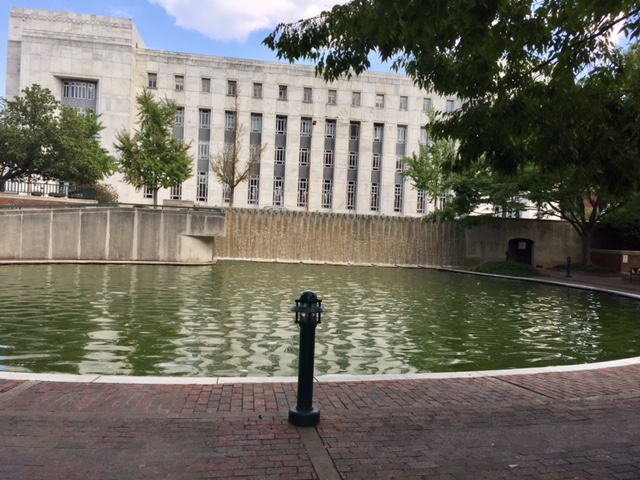
wall into a large semi-circular pond. There are lots of shady trees and benches and we zero in for a pleasant sit in the shade - until the smell in the air assaults my olfactory sensitivities. Oh, my. What a nasty stench. Putrid water? The benches around the pond are occupied by very grimy homeless people and obviously they are not affected by the pong. Me? I just stop breathing and scuttle until I can gasp fresh air.

We meet more homeless people, ranting nutters, and beggars as we make our way back to the sanctuary of the hotel. Aaah. The lovely hotel. The dining room and bar are packed with people. It is well we booked. We enjoy wine and a pleasant unhurried dinner and a safe and quiet night.

After a glorious swim and a stunning breakfast, we head out into another hot day.

We have a special quest.

My friends Mia and Ella are stranded on the road after their car breaks down and are out of money. I am trying to wire them $200. But it is

Saturday and all the banks and appropriate offices seem to be shut in Chattanooga.

We finally Google up an open Western Union office and try to find it.

Suddenly Google Maps seems to be playing games. According to the map, we are on top of our target. But this is wasteland. We drive to and fro. It is not there. Huh? But Google

says it is. We drive into back alleys and parking lots, thinking that maybe it is tucked in the rear of a building. No Western Union. We park the car and take a walk in the heat to have a close look. Down the road, around the corner. Shut businesses. No Western Union. In fact, it is a fairly dodgy neighbourhood. I’m messaging with Mia all the time. She is waiting anxiously, perplexed at the delay our end. Of all things, the Western Union office turns out to be inside a Publix supermarket. We drive up and park. It is a fabulous supermarket with a festive autumnal celebration of pumpkins arrayed just inside the door. And there, beside the checkouts, of all things, a Western Union desk. A young man gives us forms to fill out and we begin the process. An hour later, Mia has the money and we are back on the road.

But not so easy.

Damn. Missing an exit on an American highway is a ticket to chaos. Bruce is a slick master of the American road system but even he can screw up. Who knew that Chattanooga’s suburb of Cleveland was so big? Isn’t it prosperous! Around and around we seem to go, Route 11, Route 60…where the hell is Route 74? GoogleMaps. Help!! And so she does, in her cute little Aussie accent. And suddenly we are on 74 with mountains on the horizon.

And it’s over the Ocoee River pondering as to how one should pronounce its name. There’s Corn Corner with a corn maze. Ah, yet something else one can do with America’s prodigous corn crops.

Here’s the Cherokee National Forest. Oh, this is just beautiful.

There’s a huge lake which just goes on and on and trucks are lumbering along carefully delivering loads of rafts and kayaks. A whitewater river rushes alongside the road. There are the rafter drop-off points, and the rafts and kayaks on the river.

Oh, this is stunning. Around bends the river surges and splashes and whirls, the road following beside it,

close enough to give us a glorious view. This route turns out to be one of the loveliest drives in the world. Or certainly in our experience of it. We are in seventh heaven, besotted by the rapturous beauty of these mountain valleys and the whooshing, sparkling clean waters which run through them. What a joy.

Frustratingly, the road is too winding and narrow to afford a photo of the river. Sigh.

We emerge in an open valley in which sits the settlement of Ducktown, Tennessee. It is not glamorous. There are the usual food outlets and we are hungry. We try a Hardee’s which serves hamburgers and only hamburgers. Laughing, we choose the only alternative on the menu, Thickburgers. They are stunning. Generous burgers with quality meat cooked to succulent perfection. Best hamburger I’ve had, I think.

Onwards through the valley and, what? The Burra Burra Creek? There are two Burra Burras? I thought Burra Burra was an Aboriginal name, but there it is in the Tennessee mountains. And then we cross North Potato Creek. They certainly go for offbeat names in these parts.

The road winds back into the mountains amid dense forests, pop out into North Carolina where farmstands are selling Amish butter, along the Appalachian Highway and invitations to wine tastings. No thanks. Down route 19. A trading post brags ammo, tacos, knives.

The mountains have softened now. They roll like the Adelaide hills. Caravans and mini storage line the road. Settlements and smallholdings. A huge music store sits alone on its own small hill. Oh, look, there’s Christian Plumbing. Hmm

Mountains loom large again as we head past sedate homes with their vast mown lawns on the outskirts of Blairsville, Georgia. A large lake shows that the area badly needs rain. The water level is low. Pontoons sit on shores of cracked mud.

Now the town of Young Harris. No relation. I’m old Harris these days. It brags Young Harris College, gun sales, a Baptist church and an agro-tourism trail. A roar of bikers pours through it. And then it is gone and we are heading into the Brasstown Valley gasping at another vast vista of rolling Appalachian mountains. The trees are tinting orange yellow, hinting early autumn.

Onwards towards Sautee we roll, past another lake, a marina, condos, the Cornhole Country Store, developments gouged into the mountain forests, another lake complete with a white sand beach and sunshade umbrellas. An odd sight. Hiawassee is a busy town full of businesses clamouring for attention. Also full of Trump signs.

Another turn and it’s pastures and barns, hay fields and then a smooth new road which we really appreciate. We’re passing through high mountains again. The trees around us seem to reach into the sky.

And then it’s winding down again and into a valley, along the side of the Chattahoochee River with its tubing attractions, through the Alpine village of Helen with its little horse carriages and fudge shops, past the Cherokee burial m ound, the Scarlett O’Hara museum, the Old Sautee Store….and...

….we are back…sitting on the farm house screened porch watching hummingbirds again.

Saturday, October 1, 2016

Heavenly hiatus

The Sautee Store has been there forever. It is busy all day long and one imagines it has been thus for a long time; a thriving store on a crucial road junction of the Nacoochee Valley.

It is picture postcard quaint. There are rocking chairs on the porch in the grand old southern style; people passing time in the heat, chewing the fat,

watching the world go by. Rockers on the porch have always been big in the languid, steamy-hot deep south. There’s no hurry here. Sit awhile, folks.

The rusting tin advertisements on the weather-worn wood-clad walls tell of ancient cures and long-gone products. You can’t buy them inside - but you can see them. The front part of the store has been preserved as a museum, just the way it was in

the old days. There’s an old Wurlitzer there too, if one wants to recreate some atmospheric yesteryear music and tap one’s foot on the time-worn wooden floor.

The rest of the store opens up into a modern world of American candy: barrels of salt water taffy; boiled sweets; caramels; and beyond that a wealth of souvenir goodies, clothing and local foods. Of all things I am not looking for, I find some shoes.

They are colourful and pretty and make me feel as sure-footed as a mountain goat. They become my favourite walking shoes.

Next door is a rustic-style ice cream parlour and cafe. It serves Mayfield ice cream. Mayfield is my granddaughter Rosie’s middle name. I have to try the ice cream in her honour. Well, that’s my story. I choose peach in honour of Georgia, the peach state. Oh me. It does both the name and the state proud.

The Sautee Store is just a stone’s throw from the farm. There are several other little businesses around the junction including the very busy local post office. It is one of those centre-of-the-universe places with intelligent and helpful staff, Melissa and Tony, who have devoted quite a bit of time to helping me post parcels back home during this three-week break from the driving.

Prairie Trails is operated by Fred, a trader in American Indian artefacts. He’s a gruff old grey-bearded chap wearing almost his body weight in Indian turquoise.

I have bought all my stone fetishes here over the years and popped in on this trip to see what he had. What he had was strange information. The Bible says that next year, Israel will bomb Iran, he confides. And, if an owl calls your name, it is curtains for you. Oh, yes, and Trump’s amazing business skills will get the USA out of debt. Hmm.

No politics at the Gourd Place. Just gourds. Artist interpreted gourds. It’s a gorgeous gourdgeous gallery. Gourd heavens, they have gourd-given inspiration, the things they do with

gourds. It is always worth a wander.

Gourds grow and dangle outside the gallery. They bedeck the walls in an array of international uses for the gourd, from musical instrument to mask. Then there are their own inventions, some, like the little gourd fridge people, simply capricious. Others, seriously beautiful and useful. It is hard not to buy their gourd-impression pottery. I ponder shipping back a dinner service...

Just a few miles away is one of the oddest towns in the USA, Helen.

Just say the name to the locals and they go into an elaborate cringe. It is a faux Alpine Village nestled in the lush mountains. It is American kitsch on a grand scale. Of course, I love kitsch so I rather love cornball over-the-top Helen.

The locals find this confusing. Quite a few have been baffled by the word kitsch. Ironic, really, since America is the world’s great exponent of kitsch. And there is nothing kitschier than Helen, on the banks of the Chattahoochee River where tubers go squealing down the shallow rocky

waters in huge colourful inflated rings.

One of my favourite things is to look down upon the passing tubers from the comfort of the International Cafe while drinking iced tea and eating wonderful Reuben sandwiches. This visit the International had gone

right off. The food was lousy and the staff scruffy and, in one case, offputtingly grimy. A Helen cafe to write off, I’d say. We later found Mully’s Nacoochee Grill as the restaurant of the moment. I pop reviews dutifully up on Yelp and Tripadvisor as we go.

Helen gets hysterically crowded in

the summer holiday months. It is a wildly successful tourist trap. It has lots of ticky-tack shops with Alpine themes and people dress up in dirndls and lederhosen to add to the atmosphere. Yes, you can even buy lederhosen and dress up yourself. I found some faux dirndl t-shirts for my grandies, just for fun.

One of Helen’s great attractions is Helen Cellar. It is the local booze shop. We think the name is an hysterical pun, but the locals don’t think it is funny at all. Only my sister-in-law, Ginger, seems to get the joke. When I reported that on our gin and tonic buying expedition, I’d found the the assistant in Helen Cellar particularly rude in not acknowledging my cheerful hello-howzit-going-lovely-day, Ginger told me not to take offence. Of course qualifications at Helen Cellar was, if not to be deaf mute, at least to act like it.

Cleveland is a proper North Georgia town. It has a neat red brick courthouse right in its middle. Literally. It is an island around which the traffic flows with the shops and businesses on the outer side of the square.

This proud little courthouse never misses a mention as one drives through, especially as there tends to be a bit of traffic backup. It was built by Bruce’s great great grandfather, with the help of his slaves.

This is the trip in which I have gained a deeper understanding of the history of slavery in this country. Even this far on, there are still disapproving whispers about certain farmers who treated their slaves poorly. Slave history is a reality and people black and white are interested in exploring it and there is a lot of guilt and compassion. It is still a touchy subject. From the African American standpoint, this is the era of important, big-budget black museums and even what one might call slave tourism otherwise known as the “black journey”. Between the gun-totin’, Trump votin’, Christian conservative redneck locals, the old family gentry, and the genteel African Americans who come up exploring their history in these parts, it makes an intriguing and complex contemporary picture here in this beautiful mountainous deep south.

Cleveland is am old-school sensible country town, er, if you don’t count Babyland General Hospital. More kitsch. It is the home of the Cabbage Patch Doll. They are actually born there. Yes. They have midwives and nurses and birth certificates. We skip Babyland.

We go to Ingles instead. It is the local supermarket. There used to be a Piggly Wiggly which I adored just because of its name. But Ingles is a splendid, vast, handsome regional supermarket with a resident Starbucks, a terrific salad bar and hot food section, and a place to sit and eat while shopping. Hot soups turn out to be stunning. And the old-fashioned Southern hot food - corn bread and collard greens.

Ingles is also a big employer of seniors. In fact seniors are in employment all over the place, and they seem to be thriving. Check out chicks are old hat. Check out grannies are the go, with grandpas packing the shopping and helping one take it to the car. Truly.

And the helping to the car is emphatically a courtesy offered by the store. Big signs indicate that tipping for this assistance is not appropriate. Pure class.

Oh, and let us not forget the supermarket rest room. Hah. Woolies and Coles in Australia will send you out into the street looking for public facilities in Australia. Not in the USA. It is understood that people have natural urges and all supermarkets provide rest rooms. In Ingles, the ladies' room even has fresh red roses to decorate it.

We don’t do all our shopping at the supermarket.

There are marvellous farm stands. This is peach country.

It is also corn country. All of America, it turns out, is corn country. Crops from one end to another. We have watched their progress as we moved east. From tiny to tall, tall, tall. From elephant’s toe to elephant’s eye and, if you ask me, elephant’s head.

Very tall elephant at that, looking at the corn I found growing in the back streets of Helen.

Now is the time, at long last, to be eating corn. Oh, how I have dreamt of this. Hereabouts they have Silver Queen white corn, the most delicate and delicious of them all. We buy up. Also Candy Corn, which is yellow and white mixed.

We not only eat corn on the cob for lovely

lunches on the screened porch but also we have it as grits for breakfast every day. We buy our grits where they are milled.

Nora Mill is as old as the area. It is a water-driven mill on the Chattahoochee River . The corn pours into an ancient stone grinder just as it has done for ever. It is stone-ground on the spot. While you wait, almost.

The place is scented with fresh corn bread which is made right there to be sampled and to make the customer drool.

The farm stands also sell boiled peanuts, plain or spicy. They are very more-ish.

And the most wonderful, proper tomatoes. The way tomatoes should be.

Then there is okra, which is very popular in southern cuisine.

And a fruit which is new to me.

Scuppernongs.

Yes. Scuppernongs.

I did not make this up. It is the real and proper name of a little green grape-like fruit. They have tough outer skins. One nips off the top with the teeth and squeezes the centre into the mouth. Sensational. Not like anything else. Perhaps a little like tart, fresh grape soda flavour.

Muscadines are the purple sibling to Scuppernong. They are popular for sweet local wines. Some people prefer them to scuppernongs as a fresh treat. Not me.

The farm stands are very characterful and each one is famous for something. Fred brags his boiled peanuts, but I have had better. His peanut brittle, however, is peerless. And so are his spicy pork rinds.

Oh, and the family says that, for all my enthusiastic and shameless consumption of grits and spoon bread, corn on the cob, crispy bacon, pork rinds and scuppernongs, I am now a qualified southerner. I am also looking worryingly at the waistline.

No wonder people are chubby in this country.

Tuesday, September 27, 2016

On the Porch

A kerfuffle of crows is meeting in the distance, squawks of indignation, squabble, a chase…murder?

A dove flutters for cover in the trees.

The hummingbirds are undeterred. Here is one, her wings a blur against the morning light, dipping that long beak over and over in the ruby red syrup of the hanging feeder outside. It’s soft morning here on the farm in Sautee, Nacoochee, Northern Georgia.

I’m sitting in the screened porch. It’s an enclosed deck, an outside room screened against the fecundity of insect life in this moist and lush corner of the Appalachians.

This is one of my favourite places in the world.

The cidadas sing on and on and on backed by the percussive beat of the crickets. Their beautiful background noise comes from each and every tree, a density of thriving insect life, omnipresent, a joyful tinnitus.

Another hummingbird darts down making tiny chirruping calls. She drinks, drops a miniscule white poop, drinks some more and returns to the safety of the trees. Her delicate green back could be just another leaf.

I cannot tire of watching the hummingbirds. Soon, one learns to tell them apart from their mannerisms at the feeder. One, my favourite, is a tiny girl who tucks herself close in to the flower-shaped vents in the feeder like a needy baby and chirps for every suck of sugar. She hangs around when all the others have gone. I wonder if they will leave her behind when they all fly off on their great migration to South America. The boys dart in boldly but often reverse to hang in the air doing a security check around the feeder before dipping those needle beaks in again. One of the girls is the ballet hummer. She does twirl flights away from the feeder, hovering in the garden, darting and dipping around the flowers, rising and making a circle then swooping back into the green camouflage of the trees. Sometimes there is a squabble and a fierce athletic chase suddenly erupts with two little birds dashing and zipping to and fro in zigszags and arcs across the garden and through the trees. Thrrripp, thrrrip is the sound they make at frantic high speed.

Usually the sound I hear from those tiny-fast beating wings is a deep thrum.

Watching these birds gives me profound joy.

A shimmering skink runs across the porch railing outside. It waves its sleek tail in extremely graceful gestures.

Black bumble bees almost as big as the humming birds forage in the flowers. They are so hefty that the petals fold beneath their weight.

Hover flies whip around the plants, golden against the morning sun.

A cat bird calls. A blue jay. Oh, and a cardinal.

A katydid chimes in.

As if all this drenching glory of lyrical beauty is not enough, there are the butterflies. Yellow ones twirl in late summer mating dances. Huge black ones clumsily amble through the air, fearlessly pausing to bat their grand wings and display their vivid blue markings. There are little blues out there, too. Skippers. All sorts. The great tree-enclosed garden is alive, alive-o.

And the cicadas sing on and on...

These days the garden’s fecundity is beginning to obscure the true view of the great Lynch mountain outside. There is only one part of the porch left where one can see it. Libby loves the encroaching tree growth and says that able-bodied people may go outside if they wish to look at the mountain. She also says that blocking the view as has happened would break her mother’s heart, but she just loves the shade of the trees.

I am able-bodied so I stand outside to observe the day’s progressions over the saddle of the mountain. Morning mists, soft and rising in wispy tendrils. Clouds, light and free, heralding another bright, warm day.

The weather has been hot and clear almost every day.

But, one day the clouds arrived dense with the promise of rain. And then the world greened out on a glory of needed water.
And humidity descended. A small price to pay.

Sunday, September 25, 2016

Sorties from Sautee - from slaves to graves

Sautee-Nacoochee, Georgia.

If it sounds like another language, it is. It’s Cherokee. Appallingly, the poor Indians were driven from these beautiful Appalachian mountains in the 1830s. The Trail of Tears, forced removal, death march.

They are remembered here through their ancient burial mound which a rich white settler topped with a fine little ornamental pavilion. It is the Cherokee landmark which recalls their loss of land.

Bruce’s ancestors were already well and truly settled in the area with farms and churches - and slaves when the Cherokees had to leave. The Williams clan had been among the first white settlers in the 1820s. And here they are still, albeit not farming for survival but mainly returning from city careers to over-summer in the mountain cool in the old family homes. Some work at local enterprises, some have art ventures. They are all kin one way or another and the term cousin is loosely used.

Bruce’s aunt Libby, an emeritus professor of history, is the softly-spoken doyenne of this generation, custodian of the family stories and watchful steward of the her beautiful land. This farm was left to Libby together with her late sister, Marian, Bruce’s mother. Another family farm was left to the eldest child, Aunt Deda, an extraordinary pioneer
woman scientist, now deceased. But it is Aunt Libby who is the family elder and the anchor who brings the descendants together.

These many years, Libby alone has cared for this acreage with its iconic barn and pastures, stream and brambles, trees and vistas. Every spring she plants fresh flowers and vegetables and makes the most of each and every crop, just as her parents, grandparents and great

grandparents did. She is 88 and reminds us often that she is one of the few who still remembers the great Depression and lives by its rules of prudence.

Everyone adores Aunt Libby and looks forward to coming to join her on this lush place beside the grand, forested slopes of Lynch Mountain. Bruce spent parts of his childhood here and has loved it dearly. Coming here seems to nourish his

soul. Mine, too, in the 20 years we have been married and I have been coming with him to this place. It is a very special place indeed.

We are here for the grand punctuation mark of our road trip. Three whole weeks in one place; unpacking, reorganising, sending parcels home, catching up with email and books and the relatives.

We go on familiar walks with Aunt Libby along the dirt roads which wind around the mountain or through the neighbouring farmlands. Libby tells us stories of childhood swimming in the ice cold mountain waters of Sautee Creek, gossip about those relatives on the hill and the distinguished Shakespearean scholar the family produced.

She tells of Bruce's grandfather’s labours and achievements and hardships as a Methodist preacher. She tells of the family produce stand her grandmother once kept down near the highway and of the fierce bulls which caused such injury and even death to farming forebears. She tells the family stories so that they may be imprinted and carried forth.

I have my own room on the farm in

which I get to sleep in the ancestral marital bed which, by today’s standards, is absurdly small for two people. It is high and short, just right for me. I sleep here with the windows open to the cool night air of the mountains and the strident lullaby of the crickets, cicadas, and katydids. The ancestors look sternly down upon me from sepia photographs on the wall.

Bruce is close by in the next room.

Aunt Libby sleeps upstairs with her cat who will not come down and loathes any other human being other than her beloved Libby.

Soon after we arrive here, the relatives descend for a get-together. Bruce’s sister, Ginger, flies up from Florida. Cousin Nancy comes in from Colorado. Cousin Tim comes from Atlanta and Cousin Elaine from North Carolina. Bruce and I shop and cook and we all gather around

the table for family feasts and later sit around the big, cool living room by the breeze of the fan, chewing the fat as relatives have done here for aeons.

Cousin Elaine has decided she will throw a birthday party for herself while she is here. However, she has commitments in Carolina so she leaves arrangements to the cousins. Much debate and confusion. When the time comes, her new partner

leaves us with boxes of party decorations and whisks her away so we can create a spectacle of birthday surprise. Discovering the contents of the boxes and working out what to do with them provides an hilarious afternoon’s amusement which results in a house bedecked inside and outside with wild overkill of birthday kitsch. Bottles are opened. People arrive. Gifts are unwrapped. Bruce is a force of
power in the kitchen. Food is devoured. Laughter and noise. Then a quick clean-up and quiet conversations into a tired night.

Aunt Libby organises an outing for the family.

She's heard tell of the appearance of a fairyland village with amazing tree-houses in the area.

It turns out to be the extraordinary creation of a retired couple, she an artist and art teacher and he a former banker. It was his dream to build a village. In 2011 he began and now there are the most astounding towering tree-houses connected by overpasses. One even has a little bathroom and a screened porched looking out into the mountain forest. Bears out there, says cousin Tim. Turns out he’s right. Bears have quite liked this little village.

There is a little chapel and a decent sized meeting and dining house.

And, mysteriously, there is a pavilion with a bizarre art installation: pierced skulls aloft and beams covered with door knockers and keys.

The owner and builder says he buys keys by the pound weight from eBay and hammers them into wood as a stress relief. Don't we all.

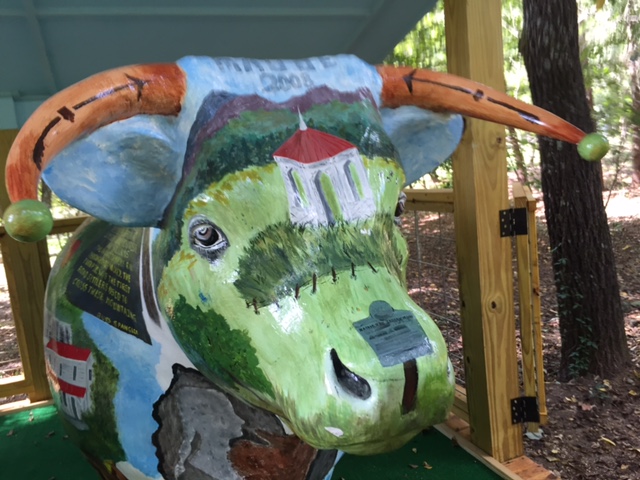
In dramatic contrast, there’s also a shelter containing two extremely vivid art cows. They were painted all over by artist friends during an arts bee. They feature local views. It is altogether a massive, complex and extravagant project. Profoundly idiosyncratic. Entirely surprising.

All this, tucked on a wooded hillside in Georgia.

You never know what people are doing, do you.

When the rellies have gone in their various directions, we resume a quiet life with Aunt Libby. Well, not too quiet. We go on expeditions.

Anna Ruby Falls is great attraction in this neck of the woods. It’s a beautiful double waterfall; crystal pure waters from the heights of the Appalachians coursing down two

adjacent rock faces and rushing off down the slopes in a sweet, rocky river. The trail up to the falls is beautifully kept and, while it is a long and winding incline, it is not the hardest climb in the world and one is constantly distracted by the sheer, ferny and mossy beauty of it all.

There are great daddy-longlegs spiders (Opiliones), vivid fungi, rock formations, fallen trees, pools and rapids, wildflowers, and information points explaining the history and ecology of the falls. At the summit of the trail, we stand on the observation deck in reverie. There is something infinitely interesting about waterfalls. One can gaze at them for ages endlessly discovering different rivulets and plateaux.

The added joy for the three of us is that we are retired people and not watching the clock. We can enjoy at leisure. And thus we amble back down the trail looking at the minutiae of nature.

In and around the pond at the bottom, we see young trout and a glory of vivid blue butterflies. More pleasurable wonderment.

There’s an excellent gift shop, too. Guess who loves gift shops and avails herself.

Brasstown Bald is the highest point in Georgia.

The family tradition in visiting Brasstown Bald is to pack a picnic.

I pack a spread of grainy bread, heritage tomatoes, kosher pickles, chili cheese, plain cheddar, buffalo mozzarella, bologna, and mayonnaise.

It’s a fair drive to the mountain and a vertiginous windy road up to the carpark. Picnic tables are set at a far-distant end where a break in the

tall vegetation gives way to a spectacular vista of mountain ranges rolling back and back into the infinite blue yonder. With this sublime view, we place cloths on the table, share out our goodies, and proceed to devour every skerrick. It is a simple little feast of exquisite, nay, perfect deliciousness. There must be something about the uber al fresco nature of the picnic that enhances the pleasure of eating. Never mind the odd yellow-jacket wasp swatted away.

Now the summit of Brasstown Bald is a serious climb from the carpark. It is 6/10 mile of steep, winding path. Most people pay $2 and take a shuttle bus to the summit. Not us. Oh no. We like our exercise. After about 100 yards of heavy climbing, I drop gratefully onto a well-placed

bench and wonder what on earth I am doing. My heart is pounding. I’m puffing hard in the thin mountain air. And we have barely begun the climb.

But there goes Aunt Libby, slowly and steadily up and up. She’s eighty-bloody-eight and she’s ahead of me. Libby sees Brasstown Bald as a challenge. She has been climbing it on and off all her life. She is an active, healthy, fit woman and she is not averse to proving it. I drag myself after her. The undergrowth is dense and tangled. Rhododendrons are dominant but there are slim pines and a diversity of interesting

trees which, thanks to the harsh conditions on the mountain, have trunks which are gnarled and contorted - giving an eerie exoticism to the eye-level tree-scape. There are some grand, sleek rocks, too. Those on the edge of the path are much-needed seats for the weary climber. Me. Even Aunt Libby is in need of rest spots now. Bruce waits patiently for us. He would really like to give the mountain a strenuous go.

There is no one climbing behind us and we are nearly at the top when we first encounter anyone - and they are coming down. Not far to go, says one woman encouragingly. She lies. Eventually, however, we are at the top. It is cool and clear. We are puffed and proud. We have climbed Brasstown Bald.

It is the most beautiful clear and sunny day and the view from the summit is breathtaking. There’s a huge lookout area so one can survey the 360 degrees of Appalachians and see into Tennessee and both Carolinas. Oh, and
Atlanta is way over there. Most interestingly for us is that we can see the familiar mountains around the farm: Yonah, Lynch, Sal and Grime’s Nose.

We sit and watch the little video documentary on the seasons on Brasstown Bald, a sweet effort with a commentary of almost lurid purple prose and we explore the competent little museum of mountain ecology and Cherokee tradition. I sit in one of

the white rocking chairs the US Park Service kindly provides for the awe-smitten mountain gazer, and I gaze, smitten with awe. Lakes and rivers and little settlements. A plume of smoke. A vivid green valley. And layers of mountains, some pointy, most rounded. These are not young mountains like the Rockies. These are ancient.

The descent is quite hairy. It is steep. One must watch one’s step and be glad of good knees. But it is dark and cool in the tunnel of mountain undergrowth. Brasstown Bald has its own microclimate. It is not like the rest of Georgia. It is similar to that of Massachusetts. There’s a gift shop at the base of the climb. Guess again who goes shopping.

Another little outing is to the Methodist cemetery where the family ancestors, including Bruce’s mother and father, are buried. It is a fiercely hot day. Aunt Libby is wearing her raffia hat. She leads us to the pleasant corner of the hillside cemetery where the dynasties lie side by side. First it is the immediate clan - the Williams. There are lots of them, neatly set around a large communal Williams headstone. Oh, there’re Bruce’s grandfather, great grandfather, great-great grandfather, and great-great-great grandfather. But there are others who married out and linked up with different names in the Nacoochee Valley. There are all the names I hear from Aunt Libby as she tells the family stories. Sosebee, Lumsden, Bristol, and Stovall.

Aunt Libby has stories here, too. Sad tales of children dying from a typhoid epidemic in 1893 and the aunt who came to nurse them also dying. She is buried amid them and her child, born in the year the others died, grew up and married but chose, when the time came, to be buried right there beside her mother. It is a large graveyard. The graves go back to the 1830s. At the far end where the forest begins, there is another communal stone, huge and imposing. It recognises the demarkation in death between the white settlers and their black slaves. In the shadow of the towering oak trees lie the slave graves. Looking through the trees, one sees almost a lattice work of iron crosses stretching away amid the bracken.

Pause for thought.

The history here is indeed full of tears.

The slave history now is studied and recognised. It is commemorated by the presence of a slave house in the grounds of the Community Arts Centre. We go for a ceremony at the slave house, as it happens. New signs of cultural explanation have been erected and are being unveiled. Speeches are given and we are all asked to step up to the slave house and place our hands on its walls and to pray. These are a very religious people. I rather like the
spirit of this gesture. There is love and sorrow. The slave house was moved from the land of one of the Williams farms. Cousin, of course. Aunt Libby points to an old photo in the slave house of her great grandfather standing in the pasture beside the farmhouse. On this wall he stood and told the slaves they had been freed, she says.

There is a family scandal about slaves. One ancestor was provided with 40 slaves by the his wealthy brother who wanted to get them out of Charleston before the Civil War finished. The Charleston brother charged his Sautee brother for the slaves although this brother was not wealthy. Then the war freed the slaves and currency was devalued but the Charleston brother would not forgive the debt. A deal’s a deal, he said. It nigh destroyed the brother and put the family in penury. To the family's credit, the years rolled by and hard feelings were forgotten. They laugh about it now. Blood is thicker than water in these parts.